


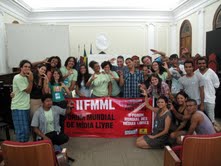
On the 16th and 17th of June the Second World Forum of Free Media took place at the Federal University of Rio de Janeiro as part of the People Summit agenda.
This second Forum was born after two preparatory meetings in North Africa (Marrakech 2011 and Tunis 2012), a first world edition in Belém in 2009, and an Convergence Assembly in the World Social Forum (Dakar, 2011). During these meetings the independent media have been shaping their own local and international agendas. Today, through their involvement in the People Summit and their adhesion to its Charter of Principles, they aim at taking a big step forward and offer their support and consolidated practices to create new forms of communication with greater involvement of people.
People from all over the world attended the meeting, representing different forms of independent media. Talks went on on the journalists murdered in Kurdistan, the strong state control on the media in Mozambique, the takeover of technology by social movements in China, the innovative legislation in Argentina and many other experiences from Brazil, Europe, Canada, United States, Africa, South and Central America. All the discussed subjects were centered around four key topics: communication rights, appropriation of technology, public policy and social movements.
On the morning of the 17th, during the last general plenary, the forum has established the strategies and proposals to contribute to the achievement of the People Summit common interests at the Convergence Assembly.
Three main themes were discussed upon during the meeting. First of all, the need to create an International Chart in defense of free media. The Chart would consist of ten key points including the right of free expression and communication, network neutrality and the creation of public funds to finance free media, among others. Secondly they established strategies and action modalities to ensure an alternative and “from the bottom” media coverage of the People Summit. The main aim is to show a different perspective on development and to give voice and freedom of expression to the various cultures that participated in the Summit and to the different social actors. breaking the hegemonic logic of information and knowledge creation, also in realtion to the Rio +20 Conference.
States must understand that freedom of information and knowledge sharing are fundamental rights to be protected, that communication is a common good as it is land or water and an essential tool for creating a responsible and conscious public opinion. Information must not become a scarce resource with restricted access that can be sold on the market and monopolized by governments and economic corporations.
What do communication and free media have to do with the environmental issue? Bia Barbosa, member of the Brailian Collective Intervozes, explains that environmental protection passes also through the free media as they give voice to different visions and possibilities for development. A new regulation for communication is therefore needed, that gives greater power and space to free media to change the reality and reach for a more sustainable and juster society.
Communication is education and part of the change and it has to aim at freedom and at the improveemenet of our reality. It should assure that men and women are recognized as subjects of their own history, rather than objects of it.
The way to achieve these results is still long and the fact that ANATEL (National Telecommunications Agency) has tried to close down the radio of the People Summit is another demonstration of how freedom of expression and communication are too often under threath.