


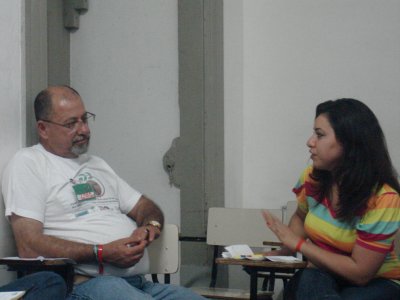
On Sunday (17), last day of the II World Forum of Free Media (WFFM), members of the Arab community and scholars debated the Palestinian question in the current political conjuncture. “I don´t think that the Arab Spring precludes the debate about Palestine. Even though this is not frequently in the newspapers, the struggle for Palestine continues and happens every day”, says Soraya Misleh, Press Director of the Institute of Arab Culture.
To Rifay Taha, a farmer from the countryside of Palestine, the current political changes in Egypt and Libya affect the whole Arab world: “We, Palestinians, continue to have the same difficulties and sufferings. But something new is happening: if the changes in Syria come, there will be changes in the Arab world and Palestine is not out of it. ”
Soraya Misleh sees changes in the forms of the Palestinian struggle and the abandonment of the Intifadas (uprisings of Palestinian civilians against the Israeli presence in their territories) due to the military superiority of Israel. “The intifadas had given way to boycotts of Israeli products as well as refusal to military pacts with Israel. It´s a peaceful and strategic struggle, in the molds of what happened in South Africa. “According to the website http://www.globalfirepower.com, Israel sets the tenth largest world military power, ahead of Germany and Pakistan.
According to Misleh, the international media coverage on the Palestinian question reinforces stereotypes and doesn´t show these other ways of struggle: “Palestine makes headlines only when there is war and blood and the Palestinians are generally conceived as terrorists. We must think how to discuss the issue and disseminate it. ”
Rethinking communication on the Palestinian question is one of the reasons for organizing the World Social Forum Free Palestine, expected to take place in the late November this year in Porto Alegre, Brazil. According to Misleh, the purpose of the Forum is to debate the reality experienced by Palestinians today: the creation of a Palestinian State, and the observance for human rights and international law.
Ciranda – Translated from Brazilian Portuguese by Fernanda Favaro